The goal was to reduce internal dependency on TechOps for repetitive tool and access requests by deploying an AI-powered agent trained on internal systems, workflows, and documentation
As organizations scale, their tooling stacks often grow faster than their onboarding or internal support systems can keep up. At our consultancy, team members frequently pinged TechOps with questions like, “How do I get a Notion seat?”, “Where is the CRM dashboard?”, or “Who owns this Slack channel?” These weren’t complex tickets — they were bottlenecks. I believed that a smart, self-serve layer could free up valuable TechOps bandwidth while giving users faster, more confident answers. That idea became Wall-A — a semi-autonomous internal TechOps agent that lived in Slack and helped everyone navigate tools, processes, and policies.
Solution:
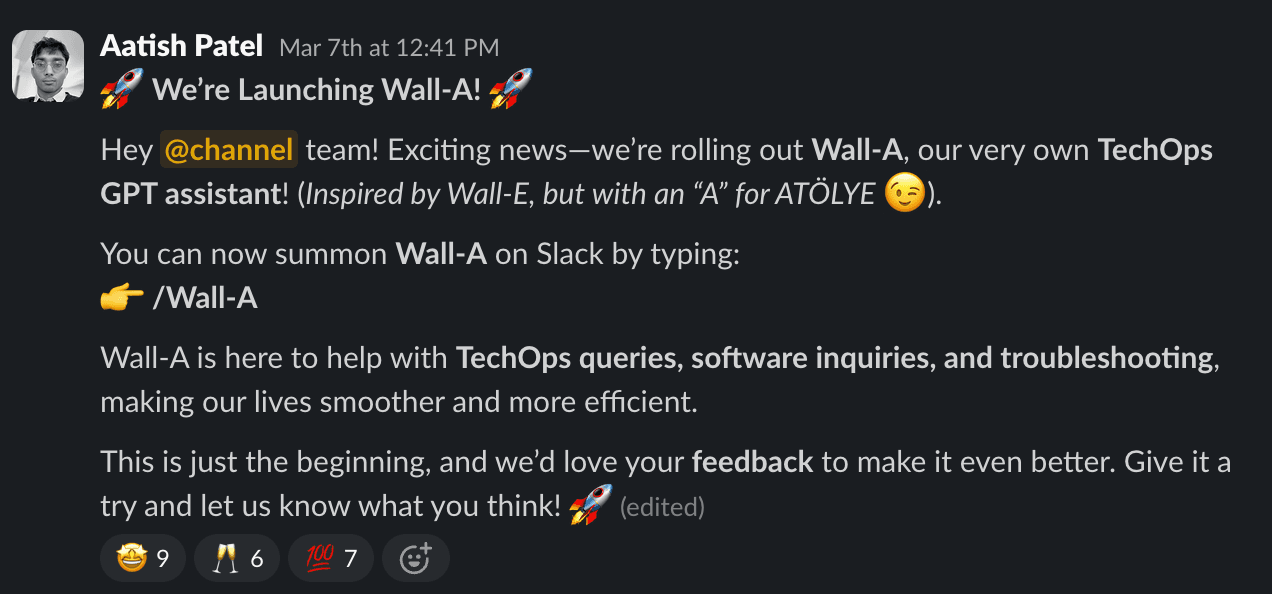
Wall-A was developed as a lightweight, AI-powered assistant that acted as the first line of support for tool-related and internal system queries. It combined OpenAI’s GPT-4 API with curated Notion-based knowledge and smart routing logic, all surfaced directly within Slack.
Key features included:
Instant answers to FAQs around tools, access, permissions, and documentation
Slack-native UX with conversational memory and confidence tagging
Custom fallback logic: If confidence was low or human input was needed, Wall-A triggered escalation forms or tagged the relevant owner
Periodic retraining based on new tools, team processes, and usage logs
Role
Audited internal TechOps tickets and Slack channels to identify common questions and friction points
Structured a clean, modular knowledge base in Notion using categories like Tools, Access, Owners, and Policies
Designed Wall-A’s conversational flow, escalation logic, and error-handling mechanisms
Built the assistant using OpenAI + Slack API + Zapier stack, with version control for prompt updates
Trained internal users on how and when to use Wall-A, collected feedback, and iterated on UX prompts
Implemented a basic metrics dashboard to monitor usage, failure rate, and team satisfaction
Impact / Results:
Handled 70%+ of recurring internal tooling queries autonomously within the first 2 months
Reduced TechOps Slack interruptions by 40%, enabling deeper focus on more strategic initiatives and furthering digital transformation within the organization.
Accelerated onboarding: new team members could self-serve tool access and setup FAQs
Helped formalize and centralize internal documentation that had been previously scattered or outdated
Boosted internal confidence in AI-enabled support systems, paving the way for more agents across other departments
Considerations:
Security and trust were critical. Wall-A’s responses always linked to the original Notion source, and sensitive tool access flows were never exposed — instead, Wall-A redirected to approved request channels or forms. We also built in audit logs for all queries and structured the system so the assistant could evolve without deep engineering dependencies.
Wall-A wasn’t about replacing human support — it was about scaling smart support with empathy and structure. It became a foundational piece in our broader automation stack — a clear signal that internal support could be as thoughtful and design-driven as external products especially in this advent of AI.